This week U.S. sanctions reached the professionals behind a trade: a law firm that registered shadow-fleet shipping companies, port agents in Singapore and the UAE, and Chinese venture-capital funds. A new U.S. executive order set a 500% duty on Russian goods and waived it at the same time, CBP gave postal importers three more months to prepare for formal entry, and China announced export controls on tunnel boring machines from 18 November. The six Notice Board topics are set out below, followed by other developments and upcoming deadlines.
This Week's Notice Board
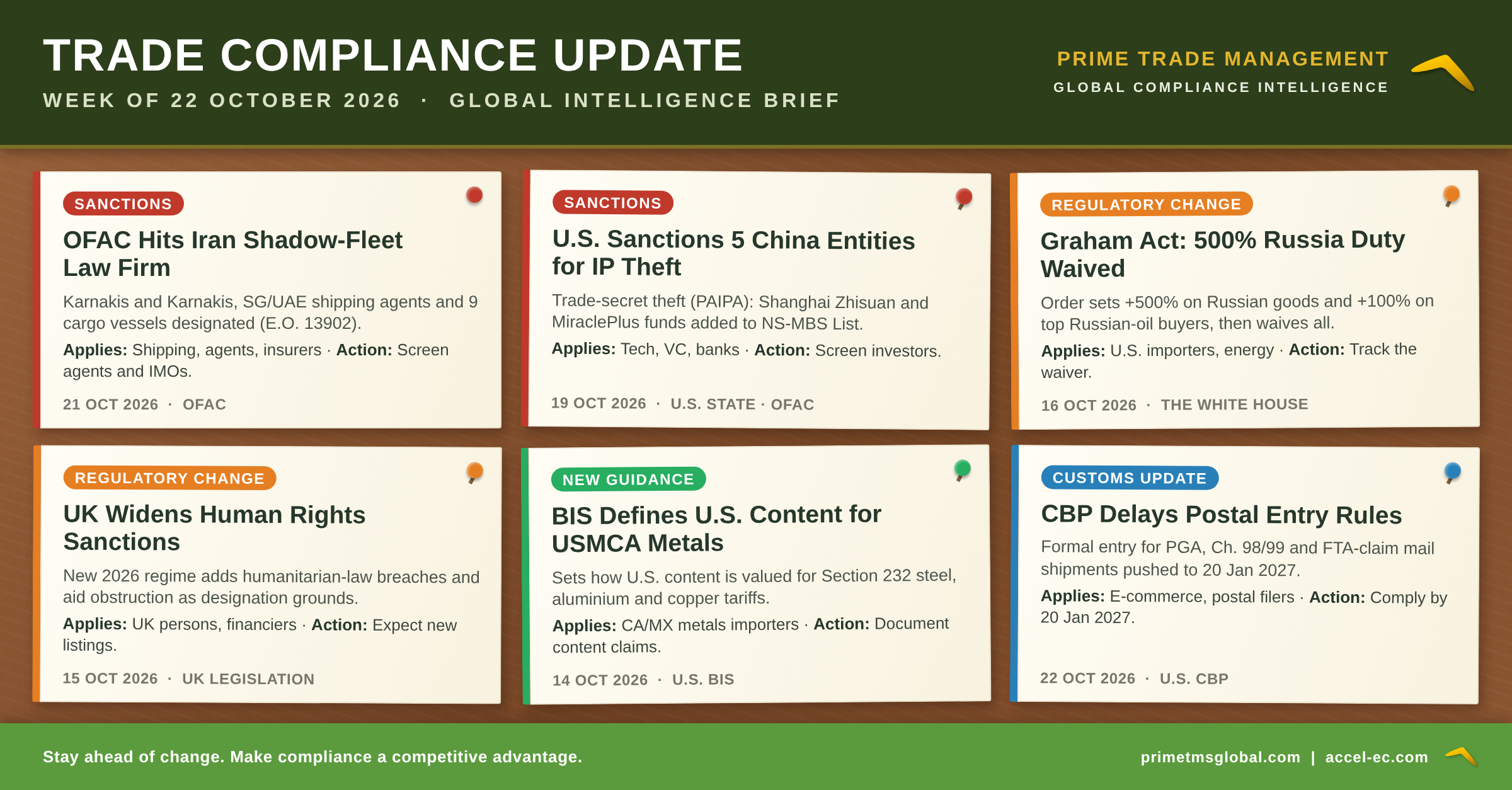
1. 🇺🇸 OFAC — Iran shadow-fleet law firm, shipping agents and nine vessels
Date: 21 October 2026 | Applies to: shipping lines, ship managers, port and shipping agents, insurers, bunker suppliers and freight forwarders
Under Operation Economic Outcast, OFAC designated Karnakis and Karnakis, a Panama- and Greece-based law firm that, according to Treasury, registered the companies owning shadow-fleet vessels that carry Iranian LPG and crude oil, with its staff acting as directors to hide the real owners. Its two owners and three employees were also designated. OFAC listed Roxette Maritime Shipping and Trading S.A., operator and ship manager of seven Panama-flagged cargo vessels and bulk carriers, together with those vessels, and Amigoz Singapore Pte. Ltd. and Whales Shipping Line LLC (Dubai), shipping agents supporting Iranian shadow-fleet operations, with two Whales crew/supply vessels. In all, 18 SDN List entries were added. Iran General License GG authorises the wind-down of transactions involving Karnakis and Karnakis, and General License HH covers wind-down, limited safety and environmental transactions, and offloading of cargo for the persons and vessels blocked that day. OFAC also issued Russia-related General License 131K (sale of Lukoil International GmbH) and removed several Belarus and North Korea-related entries.
Action required: Screen vessels by IMO number and every service provider in your documents (ship managers, port agents and corporate agents), not only shippers and consignees. Apply the 50 percent rule, and check the exact scope of GL GG and GL HH before acting on an open shipment.
Source: OFAC, Recent Actions — 21 October 2026; U.S. Treasury, press release sb0664
2. 🇺🇸 U.S. State Department / OFAC — five Chinese entities sanctioned for trade-secret theft
Date: 19 October 2026 | Applies to: technology companies, investors, fund administrators and banks
The State Department designated five entities under the Protecting American Intellectual Property Act (PAIPA): Shanghai Zhisuan Technology Co Ltd, set up in 2023 by former Google engineer Linwei Ding; MiraclePlus (Qiji Chuangtan Beijing Investment Management Co Ltd), a venture-capital firm that gave Zhisuan seed capital; and three MiraclePlus-controlled funds and entities. OFAC added all five to its Non-SDN Menu-Based Sanctions (NS-MBS) List. Their property is blocked (except for the importation of goods) and further PAIPA measures apply, including a ban on loans from U.S. financial institutions. OFAC issued PAIPA General Licenses 1 and 2, the latter for wind-down.
Action required: Add the NS-MBS List to your screening if you only screen against the SDN List. Check investor, limited-partner and fund structures for links to MiraclePlus. Use GL 2 only for genuine wind-down activity.
Source: U.S. Department of State, fact sheet (19 October 2026); OFAC, Recent Actions — 19 October 2026
3. 🇺🇸 The White House — Graham Act duties on Russia set, then waived
Date: signed 16 October 2026; published in the Federal Register 21 October 2026 | Applies to: U.S. importers, energy traders and countries buying Russian crude oil or gas
Executive Order 14436 implements the Lindsey O. Graham Sanctioning Russia and Iran Act of 2026. It raises the duty on Russian goods by 500 percent, and by 100 percent the duty on goods from the five largest importers of Russian-origin crude oil and gas (if they knowingly make new purchases on or after 18 October 2026) and from the top five facilitators of Russian oil sanctions evasion. The same order waives all of these duties, and most of the Act's sanctions provisions, under section 115 until the President or the Secretary of State decides further action is appropriate. The U.S. Trade Representative will monitor Russian oil and gas purchases. Existing Russia sanctions under earlier executive orders are not affected.
Action required: No new duty applies today, but the framework can be switched on without further legislation. Map your exposure to Russian-origin goods and to suppliers in major buyer countries, and watch the waiver status.
Source: Federal Register 2026-21599, Executive Order 14436 (21 October 2026); The White House, Presidential Actions
4. 🇬🇧 United Kingdom — wider human rights sanctions regime in force
Date: in force 15 October 2026 | Applies to: UK persons, financial institutions, investors and companies operating in conflict areas
The Global Human Rights and International Humanitarian Law Sanctions Regulations 2026 (SI 2026/1071) replace the Global Human Rights Sanctions Regulations 2020 and add two grounds for designation: serious violations of international humanitarian law, and obstruction of humanitarian assistance. Existing designations and Treasury licences carry over.
Action required: Update risk assessments for operations, suppliers and customers in conflict areas, and expect designations under the new grounds.
Source: legislation.gov.uk, SI 2026/1071
5. 🇺🇸 BIS — how to value "U.S. content" in USMCA metal products
Date: 14 October 2026 (effective for entries from that date) | Applies to: importers of Canadian and Mexican steel, aluminium and copper products
BIS published guidance to CBP on assessing "U.S. content" for the Section 232 tariffs under clause (2)(d) of Proclamation 11032. U.S. content is the value of parts wholly obtained, entirely produced or substantially transformed in the United States. To the extent not already counted, it also includes the value of steel melted and poured in the United States, and of aluminium or copper smelted and cast in the United States.
Action required: Keep supplier evidence (mill and smelter certificates, bills of materials) behind every U.S.-content claim.
Source: Federal Register 2026-20938 (14 October 2026)
6. 🇺🇸 CBP — postal formal-entry compliance date moved to 20 January 2027
Date: published 22 October 2026 | Applies to: e-commerce sellers, postal operators, customs brokers and forwarders
CBP moved the compliance date for formal entry of mail shipments that are subject to partner government agency requirements, dutiable under Chapter 98 or 99, or claiming duty-free treatment under Chapter 98 or a free trade agreement, from 22 October 2026 to 20 January 2027. The informal entry process for mail stays in place until then. A related notice (2026-21570) modifies CBP's Entry Type 13 test, a voluntary electronic process for qualifying mail shipments valued at US$2,500 or less.
Action required: Use the extra three months to build formal-entry capability for affected mail flows, or assess whether the Entry Type 13 test suits your eligible shipments. Do not treat the delay as a cancellation.
Source: Federal Register 2026-21600 (22 October 2026); Federal Register 2026-21570 (22 October 2026)
Other Significant Developments
🇨🇳 China — export controls on tunnel boring machines and drone items (19 October 2026). The Ministry of Commerce (MOFCOM) and the General Administration of Customs placed full-face tunnel boring machines and their parts, certain walking excavators and high-altitude wet shotcrete machines under export control from 18 November 2026 (Announcement No. 50 of 2026). Exports to sensitive countries and regions in dispute with China need a licence; other destinations need a registration-based export certificate and an end-user commitment not to re-export to those countries. Controlled items must be declared as dual-use with their control code, similar uncontrolled items must be declared "not controlled" with technical parameters, and customs can hold goods while it queries a declaration. Separate announcements adjusted the controls on dredger and drone items. Project cargo teams should get control classifications from suppliers and allow extra time for export formalities. Source: MOFCOM and GAC, Announcement No. 50 of 2026
🇺🇸 U.S. Department of Commerce — Canadian softwood lumber (19 October 2026). Final administrative review results set a 10.64% antidumping margin and a 14.11% countervailing duty rate for companies not individually examined (2024 entries). Update duty deposit and liquidation assumptions. Source: Federal Register 2026-21296; Federal Register 2026-21286
🇪🇺 European Union — CBAM carbon cost reminder. The Commission's Q3 2026 CBAM certificate price, published on 5 October, is €82.32 per tonne of CO₂, up from €75.28 in Q2. Each 2026 quarterly price applies to emissions embedded in CBAM goods imported in that quarter, and certificate purchases on the central platform start in February 2027. Link your emissions evidence to each shipment now. Source: European Commission, Price of CBAM certificates
🇬🇧 United Kingdom — tariff-quota balances (22 October 2026). HMRC published updated quota balances after the 21 October allocation. Most quotas are first come, first served and must be claimed on the import declaration, so check the current balance before quoting a landed cost. Source: UK Trade Tariff, Quota Volume Updates (22 October 2026); GOV.UK, Claiming tariff quotas
Upcoming Deadlines
- 18 November 2026 — China's export controls on tunnel boring machines and related items take effect (MOFCOM/GAC Announcement No. 50 of 2026).
- 30 November 2026 — Comments due on the proposed review of the U.S. Munitions List and related definitions and licence exemptions (DDTC).
- 7 December 2026 — Comments due on CBP's Low-Value Shipments proposed rule (docket USCBP-2026-0298).
- 11 December 2026 — The UN 1591 Sudan sanctions measures expire unless renewed by the Security Council (UN Press, SC/16470).
- 4 January 2027 — The European Commission is scheduled to publish the Q4 2026 CBAM certificate price.
- 20 January 2027 — CBP compliance date for formal entry of affected mail shipments.
Key Takeaways
- Sanctions now reach lawyers, port agents and investors. Screen every party named in your shipping, corporate and payment documents.
- Screen against the NS-MBS List as well as the SDN List. Some new U.S. measures are not full SDN listings.
- A waived duty is still a live risk. The Graham Act framework can be switched on without new legislation.
- Export controls can come from your suppliers' countries. Check how China's new controls apply to Chinese-origin equipment in your pipeline after 18 November.
- Postponed deadlines are not cancellations. Use the extra time to prepare for CBP's postal formal-entry requirements and for CBAM certificate purchases.
Contact Prime TMS
For automated, real-time screening against the latest sanctions and regulatory data, contact us at mcooper@primetmsglobal.com.
🔗 Try ACCEL — the trade compliance due diligence app: https://accel-ec.com